
Share this
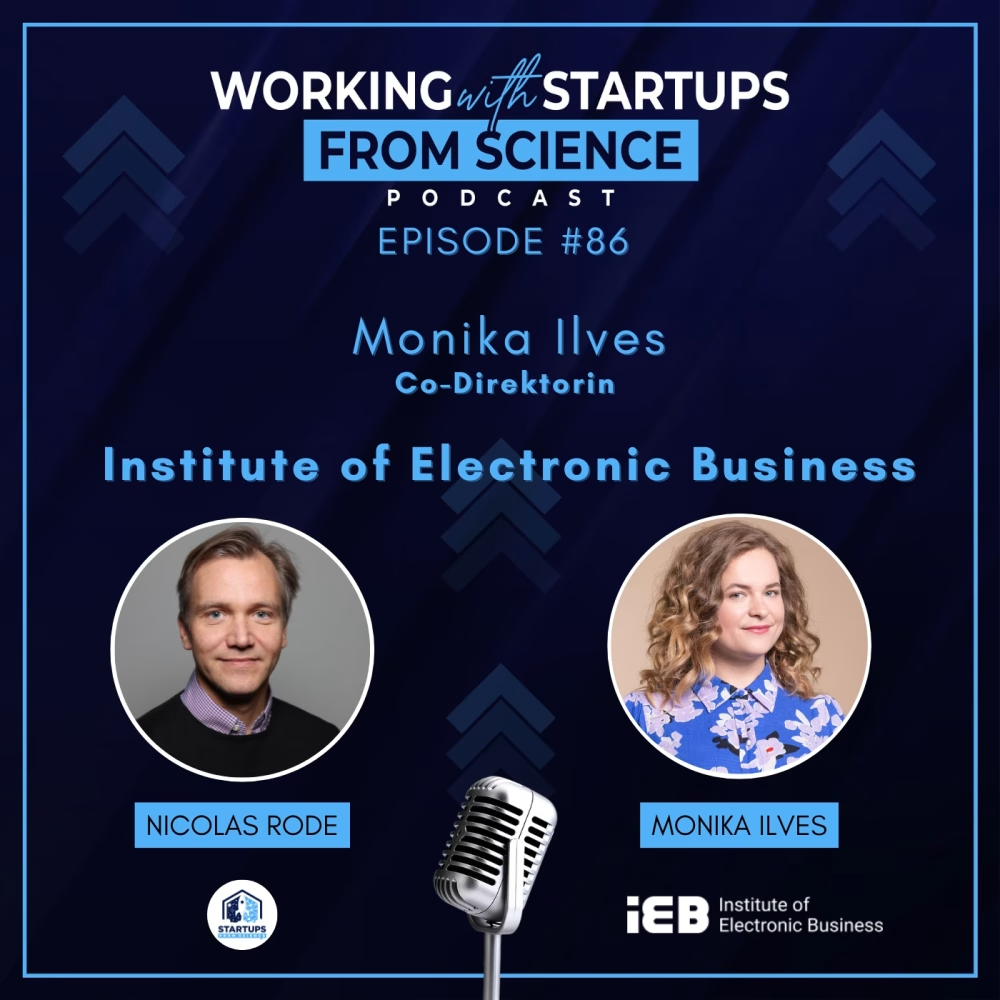
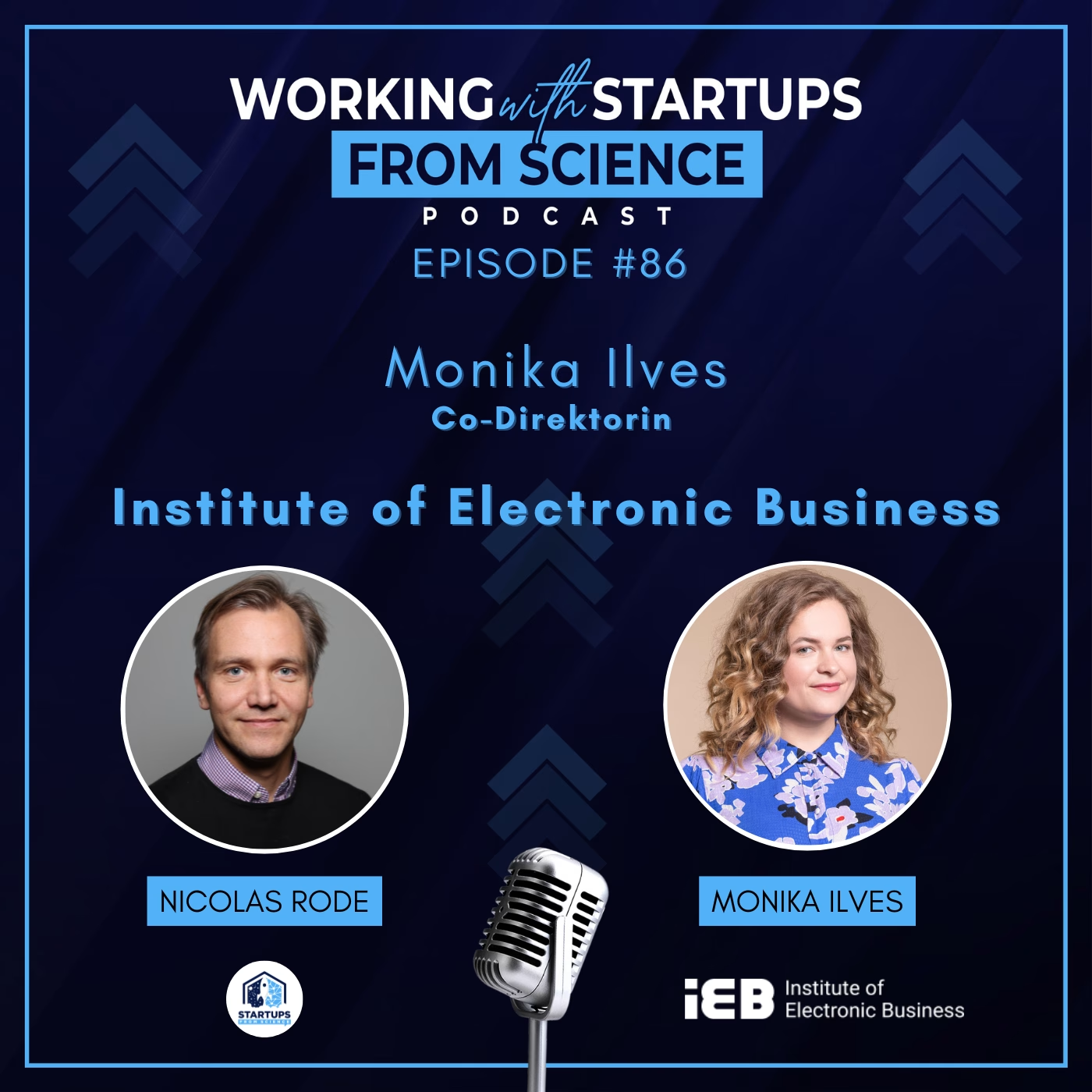 Welcome to the 86th episode of “Working with Startups from Science”!
Today we are changing the key: from uncertainty toward potential development. Today, I have a guest whom I may describe as the “first violin” in this year’s innovation orchestra: Monika Ilves.
Monika is the Co-Director at the Institute of Electronic Business (IEB) and a board member at D64 – the German Center for Digital Progress. She brings exactly the mixture of civil society foresight and academic depth that we need to grasp the societal impacts and potentials of digitalization.
What can you expect in this episode? Monika’s work focuses on Future Skills and Change Management. She supports people and leaders in growing with technology instead of being overwhelmed by it. As a coach, she offers orientation in times of uncertainty and transforms technological questions into real growth opportunities. She shows how we can master digital complexity and integrate technology in a human-centered way.
In doing so, we also bridge the gap to practice: the IEB offers orientation, the courage to change, and a network that translates AI into real innovation. The creativity of the research network and the innovation competence of the Berlin University of the Arts (UdK) thus become usable for your organization. In times of rapid technology cycles, the IEB approach delivers strategic navigation through methods, platforms, and spaces for co-creation that translate trends into concrete implementation. As a member company, you benefit from well-founded approaches. Your benefit: you don’t just understand digital change; you actively help shape it—with your own know-how, at your own pace, and along your objectives.
In this episode, we talk about talent development, (self-)leadership, and why we must not just use technology, but shape it. Be sure to listen in!
Introduction & Setting January 2026
Welcome to episode 86 of Working with Startups from Science. It is January 2026 in Berlin. It is icy cold; the streets are white and slippery. Terrorists have paralyzed an entire district in the southwest. The usual chaos of a world city. A new chapter of this podcast has begun with great joy in people, their ideas, and the question of how innovation actually arises.
Berlin is no coincidence here. This city is an innovation orchestra with many styles, many voices, productive dissonances, and at the same time, strong links to other innovation ecosystems, both national and international. Not everything runs perfectly, but much of it works precisely because of that.
Before we welcome the first violin of this orchestra today, I must briefly pause and look back. My debut last week, taking over the microphone in episode 85, was a real jump into the deep end for me. To be honest, listening back to it, there were one or two moments of “second-hand embarrassment.” But your feedback was overwhelming. It showed that this topic of Imposter Syndrome—that gnawing feeling and stage fright we discussed with Bartosz Kajdas—affects almost every founder. Thank you for receiving this new style so positively and critically.
This podcast will also never be completely smooth. Not every note will be perfect, but that is exactly what it’s about: real processes, friction, learning, people in technology, and technologies for people. Today, in episode 86, we turn the tables. The guest becomes the host. I am switching sides, going from 0 to 1. We are focusing on this new number, the 1. The one is more than just the beginning. In the periodic table, it is hydrogen—the element that makes up 90% of the universe and makes the stars shine. In computer science, the one in code stands for true, for truth, or on. And culturally, especially here in Germany, the “One” is the symbol for the top grade.
Exactly this excellence is embodied by my guest today. But before I hand over the microphone in her “salon,” I would like to say thank you once again. My thanks go to Bartosz Kajdas for the trust and the opportunity to further develop this format. And above all, I thank our first guest of this new phase for taking on this role. I therefore describe her as the first violin in this innovation orchestra that we are building this year. She sets the tone for us today when it comes to not just using technologies, but shaping them socially.
Monika Ilves is Co-Director of the IEB, the Institute for Electronic Business, and a board member at D64, the Center for Digital Progress. She works in alliances at the intersection of democracy, civil society, and technology. She works on how we can become more human despite or precisely because of AI. Her vita, and thus her know-how, is multi-layered, and that is exactly where we want to start. Before we talk about systems, codes, or regulation, we are interested in the origin. What shapes such an innovator? Where do attitude, mindset, and a sense of responsibility develop? And how did it all actually begin? Stage free for the first violin. Welcome, Monika.
Monika Ilves: Yes, thank you very much for being the first violin in your episode. It’s a wonderful introduction that is already fun. I’m looking forward to the time with you.
Origins in Estonia and the “DNA” of Technology
We are sitting here, so to speak, in your lab, in your kitchen in an—one might say—Eastern setting. We are looking down onto Warschauer Straße, and I am very happy to talk with you about where it all began. One can get some information from your LinkedIn profile. You were born in Estonia, right? How did it all start? Do you come from an entrepreneurial background? Did you have grandparents or relatives who founded companies, and what brought you to growth into a true European?
Monika Ilves: Yes, we don’t come from an entrepreneurial family per se, but I think the most striking difference was that my parents, at the time of a shortage economy—some people here will know that, also in Germany—had to constantly reinvent themselves. They set goals for themselves and tried to shape the world around them. That resulted in very different jobs, but also in the way they approached things. They tried to shape the largest possible space they could at that time in the Soviet Union, and that has remained very much in my memory, combined with technology or curiosity.
I still remember when we first had the opportunity as a family to have a computer. My parents didn’t hesitate at all to make a computer possible for our family—I have two brothers—so that we three could test things with it directly. That has remained to this day. In the sense that even today, we sit together as a family with 360° cameras, VR headsets, or drones and look at how technology works. And what interests me specifically—though we’ll probably get to that—is of course: what does this do to society?
I can imagine that really well. I also lived in Canada for a long time with a Romanian friend. Her family came from a refined house in Romania but suffered greatly under the Soviets and had to flee. They immigrated to Canada one after another. There was a lot of trade—as a doctor, you always had a full fridge because you had an important trade good: health. And then came the collapse of the Soviet Union, which was probably also a striking moment for you?
Monika Ilves: I was very young at the time, but I remember exactly the years afterward and, from stories, the years before and in between. The possibilities that opened up, but at the same time, everything collapsed. From one day to the next, the money that was worth something until then was worth nothing anymore because the Soviet Union no longer existed. You had to constantly reinvent yourself, and at that moment, you had to do it completely anew.
I think that sits in my DNA, in combination with the curiosity my parents gave us. I took that with me, also because I had to reinvent myself again when I came to Germany, which wasn’t planned forever per se, but sometimes things turn out that way.
Moving to Germany and Expanding the “Playing Field”
Did you complete your education in Estonia?
Monika Ilves: No, I came to Germany in the second grade, to the beautiful Münsterland. When I arrived, I knew two words: “Please” and “Thank you.” That was important. I didn’t know anything else of the German language. I remember the first day of school, or at least that’s when the penny dropped: okay, you are here now, and you understand neither the people nor the language nor the culture.
At that moment, as “little Monika,” it was clear to me: I have to do this alone. I had to learn the language, integrate somehow, and see that I expanded my “playing field.” For a child of 8 or 9, that’s still relatively easy. I remember going to my mom after school and saying, “I’ve found a friend and I’m going to play at her house.” My mom was totally stunned because it was my first day of school and I didn’t know the language yet. But playing always works, and as a child, it’s not so important to know the word immediately. That attitude remained; you can always reuse that, especially once you’ve reflected on what was going on inside you at the time.
A big transformation. In child research, they say between 3 and 6 years is the most intense phase for language, and then comes this autonomy phase, and you were navigating a complete transformation in a new arena, completely new terrain, just being brave and moving forward as a matter of course. And then came technology in the 90s too?
Monika Ilves: Definitely. I thought about what the pillars in my life were, and that was definitely one of them. But the other was that the confidence was there. I’ve shuttled between two cultures my whole life. The positive side is that you understand how different cultures have different approaches.
At the same time: what kind of parents send children when they are 10—and back then I was with my brother who was maybe 15 or 16—alone on a 24-hour bus from Dortmund to Estonia? We traveled alone. I flew alone anyway, but flying was expensive back then. We didn’t have the Ryairs of this world yet that allow us to travel for €50. Accordingly, you took the bus a lot, and the bus was 24 hours long through all four national borders. We weren’t really in the EU yet, so you really had to identify yourself at each border—that’s no longer the case today. I think you understood a lot along the way: we have to make it to the end and arrive in Estonia. Of course my parents were nervous, but that’s exactly the level I was always mirrored.
Overcoming national borders… you experienced acceleration and deceleration at the borders repeatedly. Hours of waiting. It’s interesting: there was this political transformation of Europe, the eastward expansion, and these countries became active, sang for their independence. Independence is also a keyword for you, right? You developed in this direction—discovering the world for yourself and leading people.
Work Experience Abroad and Networking
Traveling was always a theme for you that never let go.
Monika Ilves: True. I love traveling, especially to countries where I hope to learn something new in terms of culture or technology. That led me to Ecuador, South American countries, Southeast Asia, and then I lived and worked in Istanbul, Turkey, for a longer period.
That gave me wonderful insights into how people work in other cultures. Is it more hierarchical? In Turkey, for example, religion is integrated into everyday life. In practice, that meant our office had specific prayer times, and I sat in the middle as the European. I was allowed to observe and experience these constructs and also help lead. In Istanbul, I specifically had a team for online communication, which is what I studied in my Master’s. I think that led more and more into the gap between society and technology.
In Estonia, a different decision was made in the 90s after the fall, focusing on a long-term, sustainable variant. Accordingly, I always had a comparison of how certain systems can be or are built compared to other countries.
You worked in Cambodia for three months, coordinating, designing, and implementing tours. Then Istanbul, another world city between Europe and Asia, working with international teams at the intersection of tourism and locals. I was once a host in a surf hostel in Portugal and I know how hospitality must be a basic principle. You took that with you. You studied marketing, applied it in completely different contexts—not just locally in Germany, but elsewhere. And you qualified yourself to gain a foothold in Germany again, at Bitcom. Bitcom was founded and built in the 2000s.
Monika Ilves: How does someone get from tourism management to marketing and then to these levels? I think at the beginning I tried to gain a lot of practical experience. The broader you go, the more you can draw conclusions about how systems work.
I started with tourism because I liked the concept of giving people a kind of experience. There are many psychological anchors there. Our professor said back then: you can never walk through an amusement park truly freely again because you’ve understood which psychological levels are built there so that people walk through it the way they do. For me, marketing was the next level: I have concepts, experiences, and strategies for how I communicate with people. In marketing, I realized I didn’t necessarily have to go back to tourism; marketing brings me one step closer to technology and its levels.
Two things that are exciting in between: first, the scholarship startup network Sun, where I began contributing during my Master’s studies. In the entrepreneurial field, there’s always a bit of fear: “I have a cool idea, I’d like to do it, I’ve done the research and want feedback, but I don’t dare.” Having a network where you can test ideas and get constructive feedback without the fear that someone will take your idea and do it themselves is very valuable. It makes you less afraid because you know there are people you can ask.
To our young listeners, graduates, and PhDs: remember that. Network at the university, build your own networks if they are missing.
Monika Ilves: Definitely. I say that to everyone who asks me: the most sensible thing you can do is build a network.
And then there was the Crypto Girls Club. A wonderful woman built that in Berlin. What fascinated me there in 2018—she started building it in 2016—was the idea that when technologies are built, you should bring diverse opinions and types to the table very early on. Often, technological factors are driven by scientists or very technical people, and their way of thinking is just a typical way to think and act. Expanding that early on makes the technology more socially compatible and sustainable.
The IEB and Human-Centered AI
We have to get to the topic of Deep Tech, which drives our podcast. You are at the IEB now and you’ve taken over leadership.
Monika Ilves: Exactly, I am Co-Director together with Dr. Max Senges at the affiliated institute, the Institute of Electronic Business. We are an affiliated institute of the UdK (University of the Arts), the digital-creative level among creatives. Especially now in the time of AI, we’ve teamed up with various people to think about what is needed in these intersections I love: psychology, society, and technology.
We wrote a paper on AI for Potential Development with the thought of setting a positive narrative for the future. How do we as humans find our place in technologization with AI? Our answer is: we need more augmentation with AI instead of automation. Automation might be a short-term benefit, but the sustainable, long-term benefit lies in the augmentation of people. We are aware of critical attitudes and problematic issues, but we want to work toward this vision and discuss everything else along the way, as we have always done in Europe.
At D64, you also developed a Code of Conduct for civil society. How to handle AI responsibly at the organizational level for NGOs. And now, “AI for Potential Development” for everyone. I attended your hybrid workshop and saw how well you managed to moderate those two worlds. We talked about learning anxiety and the challenges of collaboration. I can only warmly recommend the IEB.
Monika Ilves: As an institute, we are a registered association. Our members are companies with whom we explore and discuss topics, but we also help them with strategy implementation and projects. Beyond that, we have a large network in science and various institutes. Our “superpower” is the connection between business and science.
The greatest lever in transformation is people. There are technological levers, but the biggest one is with people. If we agree that augmentation is the goal, then we need people who participate, who have no technology fear, and who dare to try things. For that, you need leadership. In companies, I often see a vacuum or uncertainty. People don’t dare to approach the technology because it would mean they have to change something. You have different levels of AI knowledge in the same team, and there’s a lot of human elements involved that we want to accompany.
Digital Sovereignty and the Future
We are dominated by American technology leaders, partly unregulated monsters, and we use American technologies. Are there European solutions?
Monika Ilves: Sovereignty is a topic we should deal with, even if the word sounds “worn out” to some. There are very good alternatives to the common tools. At D64, we use Mattermost, which is like Slack but open source. There is Nextcloud instead of Google Cloud. We see changes happening at the municipal or federal level in Germany—Munich or Schleswig-Holstein, for example, are moving toward open source. We may have missed 5 years, but it’s not too late.
Even privately, we are looking at which open-source models I can run locally on my MacBook, and honestly, they are super good. For those who are technically savvy or in science: there are ways to work locally and sovereignly with data and AI.
Sovereignty also has a lot to do with subsidiarity—breaking it down to the point where local responsibility sits. Final Learnings, could you give us your three main learnings in one minute?
Monika Ilves:
- Gaining knowledge is never linear: You have to test things out and endure a certain amount of frustration to reach the goal.
- There is no single “better” or “worse” way, only a different one: We all need to find our own way. It won’t be a general “one-size-fits-all” solution, but it is possible.
- Free yourself from expectations: We grow up with expectations of ourselves and what we think others expect of us. Ask yourself: what really excites me, what gets me “in a stir”? How can I bring that into my everyday life?
I’ll take that with me—it’s not “cheesy,” it’s brilliant. Experiment, get away from labels and expectations, and work on the anticipation of change. Thank you, Monika.
Monika Ilves: Thank you. Many people along the way signaled that things can be thought of anew. I embrace everyone digitally who has been a part of my journey so far.
Thank you. See you soon at Working with Startups from Science.
The interview in German:
You are currently viewing a placeholder content from Spotify. To access the actual content, click the button below. Please note that doing so will share data with third-party providers.