

Share this
“Pessimism is a luxury we simply cannot afford!” – This guiding principle perfectly encapsulates the impressive career of Prof. Dr. Max Senges, a visionary who doesn’t just navigate the boundaries between academia, the private sector, and philosophy, but actively dissolves them.
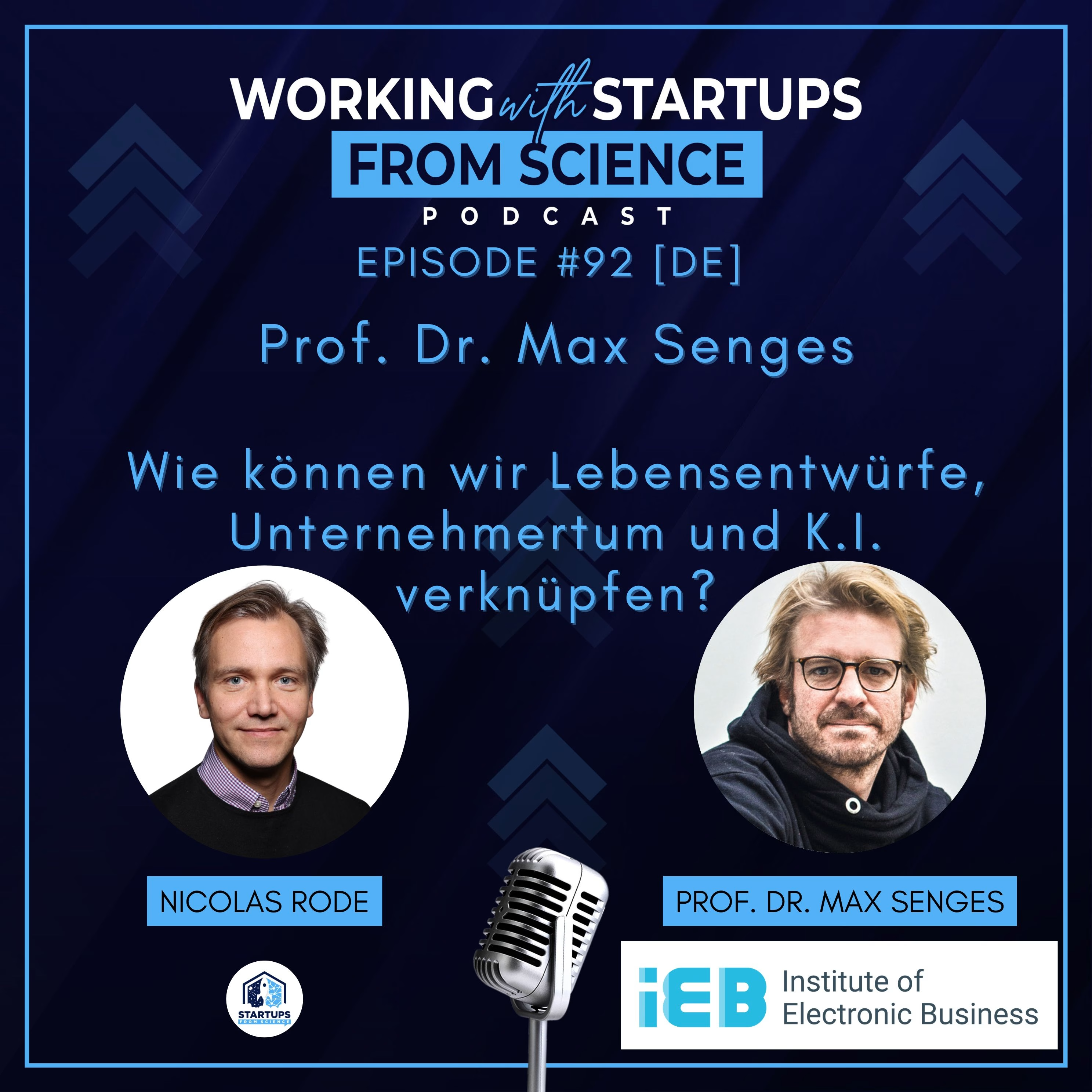
In this episode of Startups from Science, we sit down with a true thought leader. Max Senges is a Professor of Entrepreneurship at the Berlin University of the Arts (UdK) and Co-Director of the Institute for Electronic Business (IEB) – a pioneering research and transfer institute that translates academic talent and expertise directly into business and society.
From Silicon Valley to Berlin Max looks back on a 20-year journey through global knowledge ecosystems. In our conversation, he shares invaluable insights from his most defining chapters:
-
Ten Years at Google: This included four years in California as a Program Manager for Google Research, where he led the IoT R&D Expedition in partnership with elite universities like Stanford and Cornell.
-
Revolutionizing Education: Serving from 2020 to 2023 as the founding CEO and Headmaster of the innovative, peer-to-peer coding schools 42 Wolfsburg and 42 Berlin.
-
Shaping the Internet: Collaborating for over a decade with Internet pioneer Vint Cerf on critical topics like Internet Governance and open standards.
Entrepreneurial Imagination & AI Today, Max acts as an Entrepreneur in Residence at the Entrepreneurship Foundation and works as a philosophical coach. In this episode, we dive into his project Rulemapping (www.rulemapping.com), which aims to digitalize our societal “operating system.” We also discuss how to activate our Entrepreneurial Imagination to leverage the current momentum around Artificial Intelligence. Together, we explore how to actively build the companies, economies, and societies we actually want to live in.
Activating Our Entrepreneurial Imagination and Human-First AI
This is a slightly condensed version for our English-speaking listeners.
What were your earliest conscious experiences with entrepreneurial thinking and action?
Prof. Dr. Max Senges: It really started for me at the flea markets in my hometown of Heidelberg. I had an absolute blast going out there, praising my goods, and trying to decipher how a market actually operates. For me, entrepreneurship has never been just about making money; it is a profound life philosophy. It means viewing life as a vast landscape of opportunities and risks, and deliberately choosing the ones that align with who you are. It is ultimately about self-determined life design and establishing an internal locus of control. When I was 16, I made the independent choice to spend a year in Canada. There, in 1995, I witnessed the launch of the Netscape browser. I instantly realized how massively this technology would reshape the world, and the internet became my lifelong anchor for driving global change.
You discovered the digital world and chose to deepen your knowledge. How did your path unfold from there?
Prof. Dr. Max Senges: After my initial studies, I spent a few months in Africa. It was deeply transformative, teaching me to permanently pair technology and entrepreneurship with a warm, humanistic foundation. I pursued a degree in Business Informatics (Wirtschaftsinformatik), which split my time evenly between technical programming and economic thinking. Yet, I felt something was missing, so I audited philosophy lectures on “Informatics and Society” at TU Berlin to grasp the broader societal implications. While working on my diploma thesis with the United Nations, I observed a newly introduced personal management software system. Technically, it functioned flawlessly, but the employees simply didn’t want to use it. This explicitly taught me how vital it is to factor in the user from a psychological and sociological standpoint early on, which directly guided me toward my PhD in Philosophy.
That academic drive led you to Barcelona and eventually to Stanford. What did you discover during those years?
Prof. Dr. Max Senges: I was deeply inspired by sociologist Manuel Castells and his research on the network society. For my PhD at the Universitat Oberta de Catalunya, I chose a highly practical topic: investigating how the internet drives “creative destruction” within university teaching and research. I discovered that adapting to technological change is entirely a question of mindset, which led me to build a philosophically grounded entrepreneurial mindset model. Armed with that model, I moved to Stanford University for a postdoc around 2007–2008, where I discovered the freshly emerging field of Design Thinking. While at Stanford, I co-founded “Super Cool School,” a startup built around online peer-to-peer learning for topics ranging from languages to cooking. Engaging directly with venture capitalists in my mid-20s was an incredible thrill, but also a sobering learning experience.
After your time in the US, you returned to Germany and eventually wound up at Google. How did that transition happen?
Prof. Dr. Max Senges: I left my first startup and returned to Germany to found a company in Heidelberg. We provided digital consulting, training, and maintenance services for older generations—acting as “digital plumbers” for silver surfers. Just as that business was experiencing a massive breakthrough, Google called me. They asked me to move to Berlin as the second person tasked with building up their new representative office, giving Google a localized voice and engaging in dialogue with German stakeholders. I originally intended to just peak inside the corporate world for a few years, but I ended up staying for eleven years.
Q: What were your defining initiatives during your eleven years at Google, across both Berlin and California?
Prof. Dr. Max Senges: In Germany, I leveraged my background in UN internet governance to support progressive internet policy. We bootstrapped the Internet und Gesellschaft Collaboratory think tank and co-founded the Alexander von Humboldt Institute for Internet and Society (HIIG). I also worked to establish Google for Startups as a core partner at Factory Berlin. When the corporate pendulum shifted heavily toward centralization, I convinced my wife to relocate to Silicon Valley for four years. There, I led a major R&D initiative focused on open standards and interoperability in the Internet of Things (IoT) sector, collaborating with internet pioneer Vint Cerf and elite universities like Stanford, Berkeley, and Carnegie Mellon. To be completely candid, that IoT initiative did not succeed because the space was fiercely competitive and fragmented. It stands as one of my notable commercial failures, but the sheer volume of insights I gained was invaluable.
Q: Given the massive influence of today’s tech giants, does the open web still stand a chance against “walled gardens”?
Prof. Dr. Max Senges: I am fully convinced the battle is ongoing. Walled gardens and commercial platforms dominate our current phase, but the structural potential of the open web and open standards is entirely intact. Decentralized alternatives, like Mastodon systems, prove that we can step outside locked systems. It is up to us as users to actively choose services and support egalitarian standards that eliminate vendor lock-in effects.
Q: You shifted gears radically by bringing the “42” coding schools to Germany. Why is that educational model so disruptive?
Prof. Dr. Max Senges: The concept was originally created in Paris by Xavier Niel, operating on a revolutionary idea: higher education completely devoid of traditional professors or rigid curricula. It is a peer-to-peer, practice-first model where students write code, critique each other’s submissions, and defend their architectural logic from day one. I had the privilege of launching the first campuses in Germany—specifically building up the schools in Wolfsburg (partnering with the Volkswagen Academy) and Berlin, which generated 1,600 highly coveted study spaces. We require zero formal entry criteria or high school diplomas; we have welcomed many non-traditional students and refugees. Admission is determined strictly during a grueling, multi-week selection trial called the “swimming pool” (Piscine), where applicants jump into cold water together to see if this self-directed, social learning model truly fits them.
Q: Today, you are a guest professor at UdK Berlin and co-director of the IEB. How are you weaving philosophy and “Life Design” into entrepreneurship?
Prof. Dr. Max Senges: At the Institute for Electronic Business (IEB), our core mission is moving exceptional scientific talent and digital expertise directly into the economy and broader society. In my parallel professorship at the Berlin University of the Arts (UdK), I teach entrepreneurship as an art of living (Lebenskunst) to diverse creative students, from jazz musicians to opera singers. We reject traditional capitalist metrics and begin instead with positive psychology, using standardized profilers to isolate core personal strengths like curiosity, humor, and community-mindedness. Rooted in Jean-Paul Sartre’s view that we are “condemned to freedom,” I challenge these young minds to step up, make choices, and assume absolute responsibility for designing their own careers and lives.
Q: You recently joined the startup Rule Mapping. How can Artificial Intelligence fix a complex state bureaucracy?
Prof. Dr. Max Senges: Our primary issue in Germany is not a lack of regulation, but rather an accumulation of overly rigid, complex, and misapplied rules. Backed by SPRIND (the Federal Agency for Disruptive Innovation), Rule Mapping aims to fully digitalize our societal operating system. We use AI to convert massive legal texts, regulations, and corporate agreements into clean digital code to dramatically accelerate compliance and lower complexity. We operate strictly with open standards and a transparent multi-stakeholder framework. We do not act like external entities like Palantir that infringe upon sovereign state domains; instead, we build fully auditable, public tools designed to empower regulators and citizens alike.
What is the grand vision behind the Teufelsberg Campus and your “School of Survival”?
Prof. Dr. Max Senges: Berlin’s Teufelsberg is an astonishing location—a massive street-art destination sitting on a former Cold War spy station built over a Nazi military academy. I joined the team to advise on how to transform this historic space into a vibrant lighthouse for progressive education, art, and knowledge exchange. Alongside curator Georg Diez, I am developing the “School of Survival,” which grew out of a prominent museum exhibition in Hamburg. We are currently in a reflective fundraising stage, aiming to construct an educational platform that scales from teaching mainstream 21st-century survival skills all the way to hosting avant-garde philosophical foresight.
The IEB is championing a “Renaissance” centered around “AI for Personal Development.” What does a human-first AI look like?
Prof. Dr. Max Senges: My co-director Monika Ilves and I launched this initiative because modern generative AI is behaving less like a small trend and more like an unstoppable storm. Our core philosophy is explicitly Human First, not Tech First. If you approach AI with a critical and sovereign mindset, it transforms into an intellectual alter-ego or a powerful Socratic dialogue partner. It can step-by-step unlock complex fields like quantum physics or languages tailored entirely to your personal pacing. For corporate environments, we look to Garry Kasparov’s chess concept of “Centaur Work”—human-plus-machine teams. In nuanced corporate settings where human emotional resonance is vital, a team combining human empathy with AI data processing is completely unmatched. Through training programs with organizations like the GIZ, we show managers how to use AI to automate repetitive administrative work and Excel spreadsheets. The goal of the German Mittelstand is not to downsize or fire their proud workforces. Rather, it is about clearing out the noise to give employees true Spielraum (room to maneuver), allowing them the free time to think ahead, experiment, and innovate.
My Top 3 Key Takeaways
-
Own Your Life Design: A true education must empower you to look inward and rigorously answer two questions: “Who am I today, and who do I want to become?”.
-
Deploy AI for Personal Growth: Do not view Artificial Intelligence merely as a tool for corporate mechanical efficiency; use it sovereignly as a personalized accelerator to unlock your human potential.
-
Fight for Open Ecosystems: Real societal and economic resilience requires a deep commitment to open source systems, transparent shared responsibility, and collaborating openly in multi-stakeholder spaces.
