

Share this
In Industry 4.0, Autonomous Mobile Robots (AMRs) have long moved past operating behind safety barriers. They share the floor with humans, forklifts, and material flows. The goal: Maximum productivity without unnecessary stops.
The challenge: How do you guarantee absolute safety over wireless when milliseconds decide between an accident or a smooth operation?
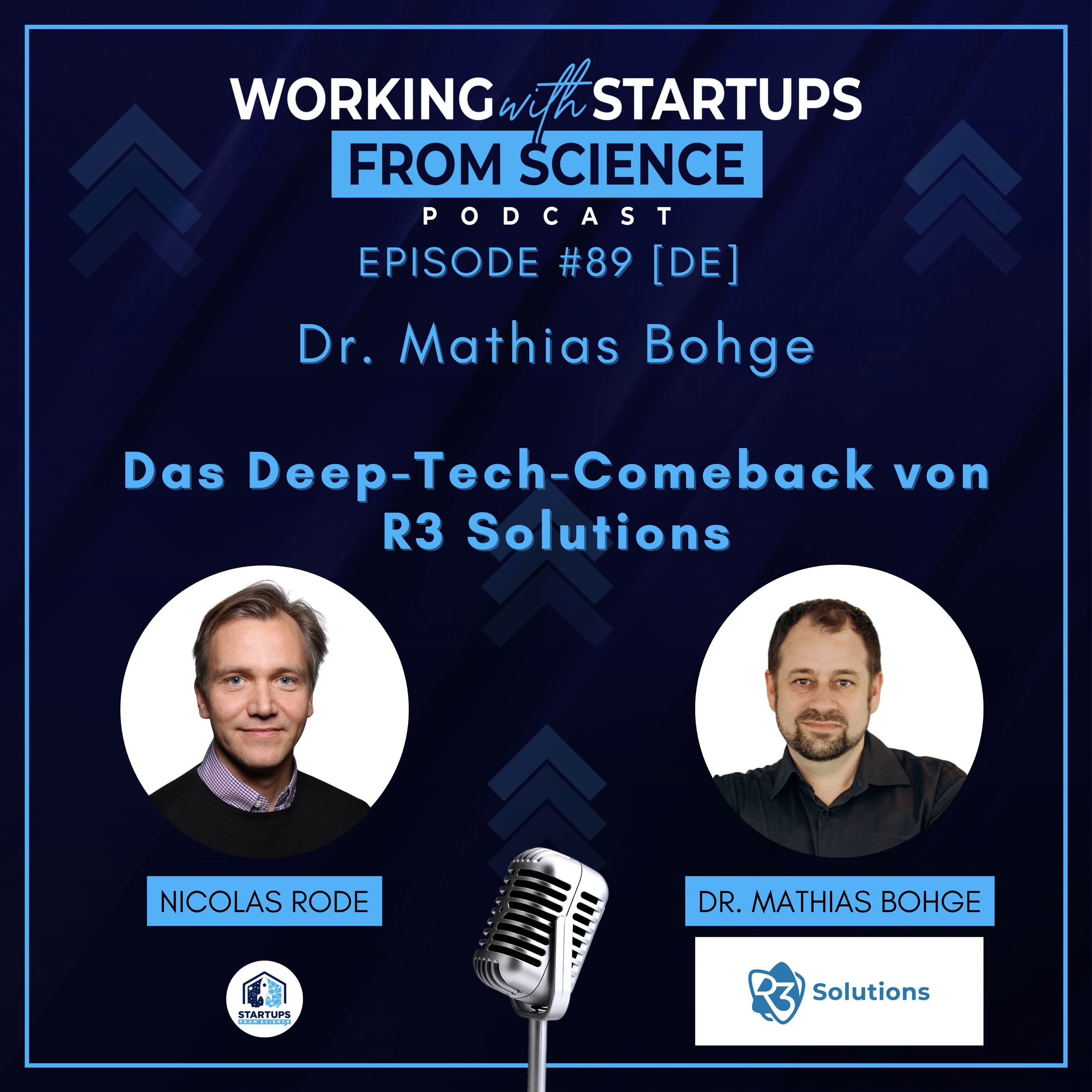
Our guest is Dr. Mathias Bohge, co-founder and CEO of R3 Solutions GmbH. Mathias is a true deep-tech entrepreneur from Berlin with a background in electrical engineering and a PhD in Wireless Communications. In this episode, we talk with him about the technological breakthrough that makes “Safety over Wireless” possible in the first place.
What you will learn in this episode:
-
The Consulting Detour: Why a career detour through a major consulting firm generates essential practical knowledge for scaling deep tech.
-
Wireless Safety: Why standard wireless solutions are often insufficient for safety-critical AMR control systems.
-
Crisis to Cooperation: How an industrial crisis and insolvency can give rise to a new strategic partnership in the high-growth segment of the “Industrial Internet of Things” (IIoT).
About our guest: Dr. Mathias Bohge
Mathias combines scientific depth with strategic foresight from his time at the Boston Consulting Group (BCG). He is a member of the Steering Committee of the 6G Platform and serves on the board of the 5G-ACIA.
His startup, R3 Solutions, is at the absolute forefront of the German deep-tech scene and has received multiple awards:
-
Deep Tech Award Berlin 2015
-
EIT Digital Challenge Award Digital Tech 2019
-
Hello Tomorrow Industry 4.0 Award 2019
This is a slightly condensed version of our Working with Startups Science – Interview with Dr. Mathias Bohge for our English-speaking listeners.
We bring you the real insights from startups from Science. Welcome to a new episode of Working with Startups Science. Today we have an expert in wireless communication who has experience in deep tech, consulting, restructuring, and scaling. A warm welcome, Dr. Mathias Bohge.
Dr. Mathias Bohge: Thank you very much.
You have a very exciting background. We always start with the beginnings, the roots. Where does this fascination for technology and engineering come from for you?
Dr. Mathias Bohge: My dad is an engineer, and he also messed around with technology a lot. He introduced me to it early on, but he wasn’t a big tinkerer himself. But fundamentally, we had a Fischertechnik set at home and I took things apart, and so on. I always found that very exciting.
And it took you quite far. You were in New Brunswick and graduated there with a degree in Computer Software Engineering?
Dr. Mathias Bohge: Yes, that’s not entirely correct. I studied at TU Berlin and did electrical engineering there. I was then in the USA for a year in New Brunswick at Rutgers University. There was the Wireless Information Network Laboratory (WINLAB), an affiliated institute of the university that focused completely on wireless communication. There were connections; the professor knew my professor from Berlin. I went over there on a DAAD scholarship back then and had the opportunity to conduct research there and get to know another country.
However, my degree is from the university in Berlin. I did my student research project (Studienarbeit) there, which was also in the wireless field, specifically on Security in Ad-hoc Networks. You can tell how old I am from the fact that I was still writing Studienarbeiten. This means I also did a Diplom; Master’s and Bachelor’s degrees didn’t exist for me yet. That was also always a bit incomprehensible to the Americans: What kind of guy am I with my Vordiplom and Studienarbeit? What is that even supposed to mean?
Same here. Good old Diplom. Did you then start your PhD as well?
Dr. Mathias Bohge: Exactly. So the Diplom and doctorate combined took nine years. America was basically right after 9/11, a year later, right when the Euro was introduced. Rutgers is located right in the New York Metropolitan Area. By train, we could go straight to 34th Street. There was a huge hole there, of course. Ground Zero was very impressive back then. It was already quite cleaned up when I arrived in August 2002, but I witnessed the ceremonies for the first anniversary and the memorial events. It was very exciting to be there.
Transitioning from “Security” to “Safety”
Did you always think of wireless networks in conjunction with security?
Dr. Mathias Bohge: Exactly. Although back then it was actually about data security, meaning IT security. In security, there are different terms. “Safety” is more about functional safety, meaning preventing injury. Back then, my scope was still security. It was about ensuring that data is encrypted and signed so that nobody can basically claim information comes from me if it comes from someone else. There are various security goals that you have to meet.
Today, I am more occupied with providing functional safety via wireless communication, because that is genuinely difficult in a wireless context.
Berlin as a Tech Ecosystem
And you’re from Berlin? You can probably best explain why this is the ideal place to research and develop in this field.
Dr. Mathias Bohge: I can definitely say that there is a strong community here, especially with the Fraunhofer Institutes. My professor back then was already a professor at FOKUS and at the TU. Then, of course, there is the Heinrich Hertz Institute, which has done a lot for hardware development. We have many players here with the TU and the former hubs.
It’s certainly not the absolute top location in Germany, but Berlin is part of it. The Kaiserslautern area is strong, as is Dresden and, of course, Munich. Berlin has the advantage that the city itself is a very attractive location. We have the opportunity to inspire developers from all over the world to join us. It’s a bit different going to Berlin compared to maybe Kaiserslautern or Dresden.
Do you see decentralization in Germany as a disadvantage compared to clusters like in South Korea?
Dr. Mathias Bohge: There are arguments for both. I think a lot of parallel research happens here, but in return, you get competition. We know from China that multiple teams often work on the same topic, and only the best team makes it through. We could pool forces more, but changing established structures isn’t easy. Every cluster has its own focal points: some focus more on hardware, others on the physical layer or the upper layers. The BMBF will have thought it through carefully.
Corporate Exposure at Ericsson and the Management Path
And from here, you’re not far from Stockholm either. You then jumped over to Ericsson to get your first taste of corporate life?
Dr. Mathias Bohge: I wouldn’t describe myself as a full-blooded scientist, because for me, it didn’t stem from a deep desire to contribute to the research landscape, but rather it just happened to me. I wrote my Diplom thesis in the field of 4G, specifically on OFDMA (Orthogonal Frequency Division Multiple Access). That is a combined modulation and access scheme which is the standard that brings the most efficiency for 4G, WiFi, and now also 5G. When I finished, Ericsson was there and asked if I would like to write a doctoral thesis on the topic. I didn’t have any other ideas and said, “Sure, I’ll do it.” A doctoral title also always sounds quite cool—at least that’s what you think when you don’t have one.
I am one of those people who doesn’t like to dive extremely deep into a single topic, but prefers to know a lot of things on the surface. That is probably also the reason why I am now more active in management and used to be a management consultant. For the doctoral thesis, I naturally had to dig deep, but there were many grueling hours involved. My professor always said a decent engineering doctorate takes at least five years, otherwise you won’t make it to the top. I dutifully did that, but it didn’t really fill me with joy. After five years and three months, that was the end of research and development for the time being.
Where did you develop this discipline? What was your north star during this phase?
Dr. Mathias Bohge: Our institute was just super cool. It was fun to work with people from all over the world—from Sweden, Portugal, Africa, Hungary, the USA. It was a great time. And when you know that doctoral positions funded by third-party grants are decently paid, then it’s a job that brings you money and allows for highly self-determined work. I was never that self-determined again, neither as a managing director nor as a management consultant. The setting was great and the topic was exciting.
I can feel joy when I build up knowledge and see that I can contribute something. I even won a Best Paper Award once at the European Wireless Conference. Nevertheless, I often sat at conferences thinking, “None of this really interests me.” One of my personal traits is: I am very bad at letting things go. Quitting gives me a bad feeling. This trait carried me through to my Diplom and my doctoral thesis.
Joining BCG and the Reality of Burnout
That was the building block for your career. Afterward, you went straight to one of the Big Five, the Boston Consulting Group (BCG), as a consultant?
Dr. Mathias Bohge: Exactly. It was the desire to look out from that laboratory corner again. Once you have researched a topic for five years, you eventually know all the faces and know what is possible. I didn’t have many job offers. As a member of Gen X, who are always afraid of not finding a job anyway, I applied to Siemens, Telekom, and other usual employers. Nothing came back except from Ericsson. Telekom told me to get back to them in half a year, and Airbus hasn’t replied to this day. So there was this feeling: “Great, now I’ve built up mega expertise, but nobody actually needs it.”
At BCG, I had done a workshop for engineers during my studies. They are interested in multidisciplinary teams. I wanted to be part of that. The tagline was “Thinking is Action.” Only one percent made it through the application process, so ambition gripped me. In the first interviews, I was very relaxed, but once I passed the first round, I wanted it so badly that I wasn’t so relaxed anymore. It worked out anyway.
These consultancies demand an incredible workload. How did you find a balance?
Dr. Mathias Bohge: The PhD period had left a lot of free time. I always made a lot of music, played in bands, was a choir director, did scout work at church, and was on the board of a small NGO. Theoretically, that gives you the strength to ground yourself. When you sit around with too many millionaires—which happens during consulting meetings—you start getting into strange mindsets. In those times, it’s good to stand in the stadium stands with people who come from a completely different walk of life.
That kind of thing brings strength in theory, but in practice, after a bit more than a year at BCG, it put me in a capsule—with reactive depression, a burnout. It was hard for me not to see things through to the end. I thought I could just keep living my life as a consultant: youth work, choir, playing the organ on Sundays, soccer. Overall, it was too much. I didn’t see the red line, and as someone who always manages everything, I was thrown back down to earth. I found myself in the Charité, was there for two months, and out for a total of six months.
How did your environment react? That must have been a tough time.
Dr. Mathias Bohge: It was the hardest challenge of my life. I wasn’t used to not performing. With depression, you feel like it will never get better, and you can only envision paths negatively. When I meet people in a depressive phase today, I say, “Remember, everything will be fine again.” The circumstances don’t change, but your own perception changes massively due to the chemistry in your head. Fortunately, we have good care in Germany. That was life-saving for me.
After six months, I was the first consultant at BCG to reintegrate using the “Hamburger Modell” (gradual reintegration plan). All colleagues before me who had problems left via a Special Leave. Officially, burnout didn’t exist in BCG consulting—I was the first. Human Resources asked me to stand by it so they could begin setting up training and measures. My case was discussed at the executive board level. I spoke a lot with our CEO at the time and basically became his right-hand man for communication within the firm. I was responsible for internal communication at BCG Germany and Austria and worked on establishing seminars and positions for those affected.
Powerful. Strength was created for the organization out of that honesty.
Dr. Mathias Bohge: During the depressive phase, everything was up for debate, including whether I would return to BCG. But the company treated me so well. I was met with extreme positivity—starting with flowers in the hospital and visits from the office leadership. The message was, “You’ve suffered a setback, but you are valuable to us. Take your time.” My doctor said at the time that such openness was present in very few companies; that it was a safe environment for me.
I spent a total of four and a half years at BCG. I stayed longer because, with the new role and what I had learned about myself, I saw that I could make a difference there.
The Birth and Funding of R3 Communications
Dr. Mathias Bohge: I met my business partner Florian at BCG. By the way, my wife is an artist; she paints in oil and acrylic. A completely different path, which is super exciting for me. Compared to her circle, I am very “square” and money-oriented.
I knew from Florian that he wanted to start a business. I connected him with guys from my past who had developed the system we later commercialized. Christian had developed it during his doctoral thesis with his professor, James. My own involvement was rather accidental because I never wanted to found a company. But once I realized it was exciting, I didn’t want to have that “fear of missing out.” If it really takes off and I’m not part of it, I’ll be incredibly annoyed.
I actually didn’t want to start a family and a company at the same time. I left BCG when my wife was pregnant. I thought moving from a consulting job into your own company would be counterproductive, but I did it anyway. Working as a consultant on the side served to bootstrap the company.
Did you bootstrap completely, or did you use public funding?
Dr. Mathias Bohge: We didn’t do the EXIST program, but Florian initially did it through a startup grant (Gründungszuschuss) from the employment agency. There was follow-up financing from the state. We looked into programs early on, received a SIGNO grant for our first patent, and were able to quickly win projects through contacts at BMW and Bosch, which brought 100,000 euros into our cash reserves. We never managed to do that as easily again later on.
Through partnerships with Schleicher Elektronik, we received a PROFIT early-stage financing of 400,000 euros from the state of Berlin. It was half loan, half grant. It was a mixed calculation of savings, side-hustles, projects, and public funding. We only received the PROFIT funding because we were simultaneously able to attract business angels. Three angels helped us and formed our advisory board: Uli Schmitz from Springer Ventures, Holger Spielberg (CIO of Aareal Bank), and Andreas von Zitzewitz, formerly on the Infineon executive board. They thought the idea was cool and put in their own money.
Who was the financial eye?
Dr. Mathias Bohge: Florian. We had hired tech guys who took care of the technical side. The division of labor between CTO and CFO worked well because we knew each other from BCG.
Navigating the Deeptech Roller Coaster: Awards & Real-World Lows
You won awards, like the Berlin Deeptech Award or international honors. Do these awards give you a tailwind, or do they generate pressure to perform?
Dr. Mathias Bohge: Not pressure to perform. An award generates a lot less publicity than I would have thought. You have to say it yourself, otherwise nobody knows. The Deeptech Award in Berlin brought 10,000 euros. We bought a cool coffee machine with that to attract good developers.
Schleicher Elektronik was an established player and was supposed to build the hardware to connect control systems wirelessly. When we were finished, Schleicher was bought by a Chinese company and went insolvent three months later. The new Chinese owners didn’t want to cooperate with us. We were left sitting there with software for a device that wouldn’t exist. That was a real low point after two and a half years. Fortunately, we were able to convince the investors that we could get our own hardware up and running.
We won great awards, like the Hello Tomorrow Award in Paris—the IoT Track. There was 15,000 euros for that. In China, we won the International Entrepreneurship and Innovation Award. They offered to relocate everything to China, including a free office and one million euros. But that wasn’t possible because we had venture capital from the state of Berlin (IBB). Plus, COVID hit shortly after, so it probably would have collapsed anyway.
We were with Airbus in the Bislab Accelerator in Hamburg. We built a business case for wireless features in the aircraft cabin. A frequency band at 4.2 to 4.4 GHz was reserved specifically for “Wireless Avionics Intra-Communication” (WAIC). Airbus was the driving force. But the French aviation authority rejected it and demanded revisions with lower power output. Then COVID hit, Airbus sent everyone home, ended the program, and didn’t pay the funds. Six-figure project amounts didn’t materialize. The investors said, “Oh, now the business case is gone, I don’t believe in it anymore either.”
Shortly before that, we were at an all-time high because we had won the EIT Digital Challenge. For a year, we were named “Europe’s most valuable company in Digital Tech.” There was 100,000 euros for that—50% cash, 50% in services. Through this, we got into the EIC Accelerator (formerly Horizon 2020), where you can get up to 2.5 million euros for a project. We had Letters of Interest from Airbus, Lufthansa Technik, Ariane, and Liebherr. We actually won it and were supposed to receive 2.5 million euros, but it didn’t come to that either.
Incredible, what a roller coaster. How did you navigate through that?
Dr. Mathias Bohge: Supply chains weren’t the main problem, but rather that clients could no longer integrate systems or had other issues. The mood between management and investors worsened. The funds all closed shop; nobody wanted to make new investments. I had to stand before my team and show radical honesty.
Going Through Self-Administered Insolvency
What was it like with the insolvency?
Dr. Mathias Bohge: We believed in the technology and the team. We didn’t want to just throw it away, also because of the people who had put money in—like my mom. One advantage of COVID was that there were special regulations for insolvencies. Without self-administration (Eigenverwaltung), it wouldn’t have been possible as a small, unprofitable venture. A receiver in a normal insolvency has personal liability and, if in doubt, quickly shuts everything down. In self-administration, you get a trustee (Sachwalter) from the court who advises the management.
We had a conflict of duties: we had to pay social security contributions (according to the BGB), but we weren’t allowed to spend any more money (according to insolvency law), and we had to grant the investors a grace period for remedy. We calculated the employee share for each employee and transferred it to the health insurance funds—but only after notifying them by registered mail that we were about to transfer it, but that it didn’t belong to them and they had to return it immediately. This way, we fulfilled our obligation to pay, but we hadn’t technically “spent” the money. All health insurance funds actually sent it back.
We held onto the patent portfolio in agreement with the trustee. Every payment has to be weighed: is it better to save 1,000 euros in fees or keep the patent? Otherwise, you can ultimately be held personally liable. For three months, you get insolvency payments (Insolvenzgeld) for the employees. If you want a solution, it has to happen within these three months.
We achieved a “restructuring by asset transfer” (übertragende Sanierung). A new backer bought the assets from the old R3 Communications and placed them into a new structure. The employees were all able to stay (Paragraph 613a BGB). In the end, the industrial holding company Peppermint bought the assets because they wanted to enter the field of factory automation.
Resilience and the Technical Edge Today
Unbelievable, what kind of resilience you have built up.
Dr. Mathias Bohge: During R3, I was in a depressive phase once more and stepped away for two to three months. Fortunately, Florian and James were there. My advantage was that I had already gone through it before and knew how to handle it. I know that I take business matters like an insolvency quite well. It gets harder for me when things become personally emotional or when I disappoint someone. During the insolvency, I fought for the employees and the shop; that was helpful for my self-image.
Today, we are very active in the automotive sector. We are the only company worldwide that has access to the source code of the WiLink chipsets from Texas Instruments. We have clients like Rivian and are in partnership with VW. Deep tech is a massive initial investment. Now we have showcase clients. When industries operate their plants for 20 years, it’s hard to say: “We are three years old and our solution lasts 20 years.” Now we are nine years old, part of an industrial holding company, and have systems that have been running stably for six years. We equip warehouses and production lines with our highly reliable wireless communication.
The robots in the warehouses look like little cubes zooming across the warehouse floor.
Dr. Mathias Bohge: Exactly. We have customers like Art Foromans from the Netherlands. The special thing about our technology is that it is deterministic. I can rely on being able to transmit a data packet at a specific point in time. Normal WLAN uses CSMA (Carrier Sense Multiple Access)—you listen to see if it’s free and then start sending. If two send at the same time, there is a collision, and you have to draw a random number to determine when to try again. That doesn’t work for robots or emergency stop switches that need their data every few milliseconds.
Our system uses a token-passing procedure. Like a stone at the scouts: everyone is only allowed to speak if they have the stone. Every participant gets the token packet and must forward it after a fixed time. With ten participants and a hold time of one millisecond, one round is finished after ten milliseconds. That sets us apart from WLAN.
The Role of AI and Upcoming Events
What role does AI play?
Dr. Mathias Bohge: AI shifts the workload massively; we can program much faster. We already used AI in research projects five years ago to make predictions about channel development. However, it hasn’t made its way into the products yet. Whoever has the spark of inspiration there can really strike it big.
Next week on Monday, March 30, we have an Expert Talk with Philip Pospelov from Service Control. We equipped autonomous robots at a Czech car manufacturer. It was about the cooperation between robots and employees. If a human gets too close, the robots stop. We have created a way to integrate the robots into the infrastructure safety zone via existing safety protocols. Anyone who wants to take a look is cordially invited.
We are at the end of the journey. Do you have a few learnings left?
Final Key Learnings
-
Life Wisdom: Everything will be fine again. You shouldn’t punish yourself so much, surround yourself with people who are good for you, and realize that life has more to offer than just a company or a single life plan.
-
Technology: It takes time. Tell your investors right from the start: “You won’t get your ROI in three years.” If it’s a real tech topic, it takes ten years.
-
Team: My learning is: Absolutely co-found with people you like. You shouldn’t hire them just because you like them, but you should look forward to going to work. The team is the safety net in the “foxhole.”
-
Shoutout: Believe in yourselves. Innovation comes from the little guys. That is important for our entire social fabric. Friends, keep innovating!
That was the episode with Dr. Mathias Bohge, CEO of R3 Solutions. We look forward to the next episode of Working with Startups Science.
