

Share this
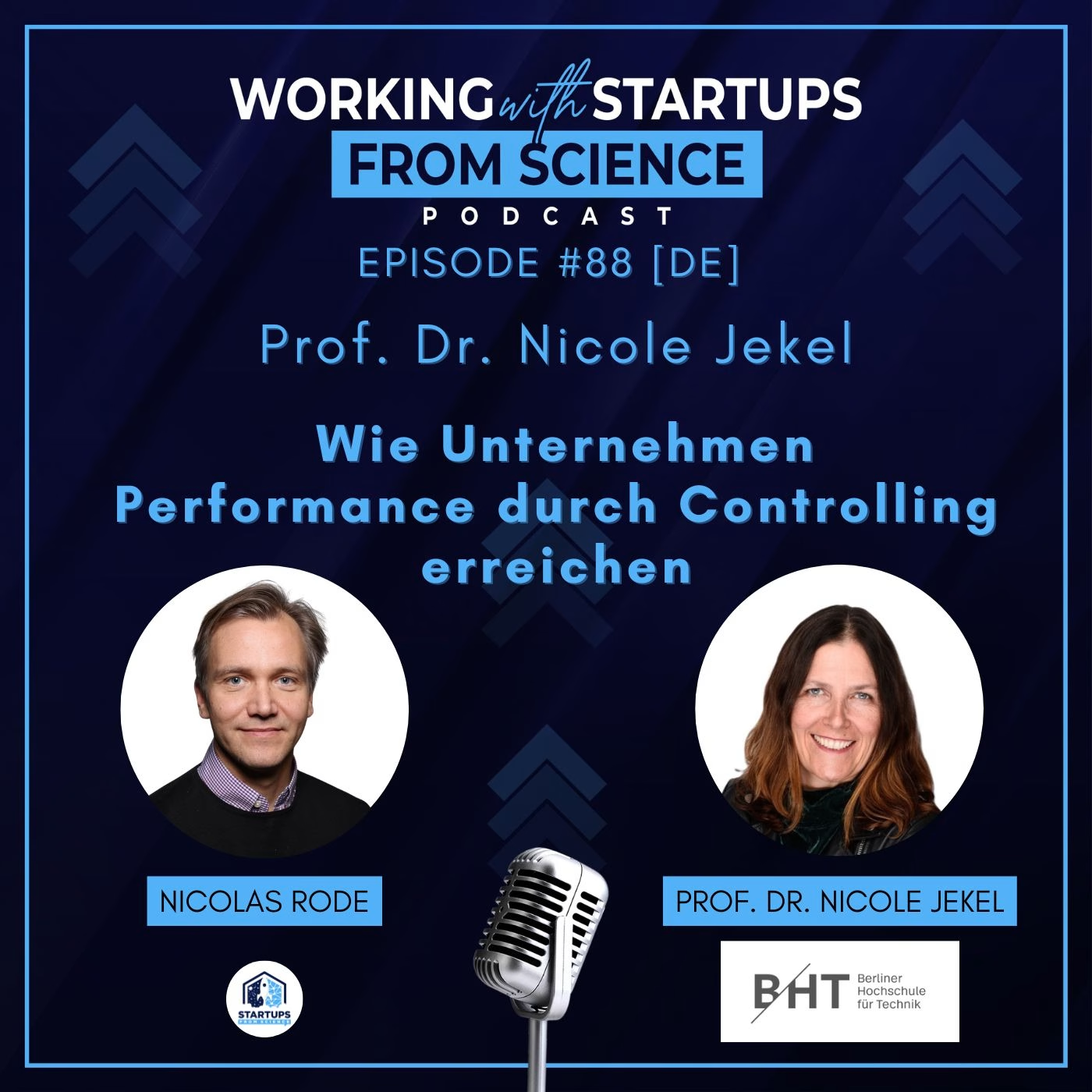
In episode 88 of startupsfromscience.com, Berlin-based host Nicolas Rode welcomes Professor Dr. Nicole Jekel from the Berliner Hochschule für Technik (BHT). Together, they dive deep into the world of numbers, artificial intelligence, and the entrepreneurial mindset. As a self-proclaimed “creative chaotic” who simultaneously possesses the discipline of a “structure queen,” Nicole Jekel is anything but a conventional professor. Learn how she discovered from her grandfather—whom she considers the “best cash manager in the world”—that counting translates to freedom , and why she builds AI bots today to tame German bureaucracy.
This is a slightly condensed version for our English-speaking listeners.
What was it like for you growing up in the industrial heart of the chilly, small West German Republic?
Prof. Dr. Nicole Jekel: I had an idyllic and dreamy childhood in Dortmund and Unna. Although school wasn’t particularly important to me back then , I passionately wrote lists over lists —looking back, those were clearly the first signs of a controller without even knowing it!
After finishing high school, you became a working student. Who in your family shaped you from an entrepreneurial standpoint?
Prof. Dr. Nicole Jekel: My grandparents Ella and Paul were entrepreneurs in Dortmund who built up hardware supply stores long before major chains like Obi or Bauhaus existed. My grandfather was truly the best cash manager I have ever known. In 1988, when I graduated high school and wanted to study business administration , he gifted me a computer with a 286 processor. He told me it was the best inheritance he could ever give me because I would absolutely need it. Armed with that computer, I was the absolute heroine during my practical work placement because everyone wanted to use it.
You then completed a dual study program. Why did your time at Heinz Nixdorf leave such a lasting impression on you?
Prof. Dr. Nicole Jekel: Nixdorf in Paderborn was a sacred place where you truly learned entrepreneurship. One specific practical experience shaped me deeply: during my time as a student worker, I was given a fixed book budget —let’s say about 1,000 Marks/Euros —and I could decide entirely on my own how to spend it. I wasn’t held accountable for the specific choices. I found this sense of freedom within a broad framework incredible. It taught me how to define rules of the game: you set up clear guardrails (Leitplanken) on the left and right, and within that corridor, people can act freely. This is a principle I frequently adopted later in my own leadership roles.
Some modern accelerators call that “de-risking”—giving a team a budget of 300,000 Euros and letting them hit the ground running. You experienced that de-risking very early on. After that, you spent 20 years at Siemens, during which you completed an Executive MBA and a PhD in England. What drove that path?
Prof. Dr. Nicole Jekel: I realized while working at Siemens that I wanted to expand my horizons and learn more about scientific models and leadership guidelines. The Executive MBA at Bradford was a hybrid distance-learning program completed back when we still relied on ISDN cables and modems. In England, I was fascinated by the positive mindset and the fact that the professors treated me entirely as an equal. I didn’t experience that kind of two-class society that was prevalent in Germany at the time. After that, I was hooked and applied for a PhD—specifically a Doctor of Philosophy rather than a DBA—because I knew it was the globally recognized academic degree required if I ever wanted to become a professor worldwide.
Armed with that PhD knowledge, you returned to Germany where Siemens put you in charge of sales control for a massive 1-billion-Euro budget. How do you navigate and steer such massive sums?
Prof. Dr. Nicole Jekel: It was an incredible challenge, but ultimately it was a collective team effort. We reached that billion-Euro revenue target because I was able to test and deploy a variety of controlling methodologies. It required a carrot-and-stick approach, constant tracking, and practically daily follow-ups. You have to steer both the numbers and the people emotionally. Interestingly, despite being tucked away inside a massive DAX corporation, our specific division maintained the high-energy atmosphere of a small startup.
How did you make the final leap from a 20-year corporate career into academia as a professor?
Prof. Dr. Nicole Jekel: A close colleague kept nudging me about it. I deliberately targeted state universities of applied sciences (Fachhochschulen) because I didn’t want to complete a habilitation and preferred a highly application-oriented environment. My very first interview “audition” in Hamburg was a disaster because my communication style was far too DAX-oriented; they were highly pedantic and didn’t want to hear a single English corporate term. But then the Fachhochschule Westküste in Heide called. They wanted me exactly as I am, without making me bend my personality. I was appointed as a professor for both marketing and controlling. Later on, I accepted a call to Berlin at the Berliner Hochschule für Technik , partly because our daughter Nina had finished her high school diploma exceptionally early at the age of 16 and wanted to study theoretical mathematics in Berlin.
In Berlin, you teach a lot of engineers for whom controlling is often just an annoying, mandatory minor subject. Do you see the classic Gaussian bell curve manifest in your classrooms?
Prof. Dr. Nicole Jekel: Coincidentally, my office in Berlin is actually located inside the “Haus Gauß” building! And yes, I can absolutely confirm the reality of the Gaussian bell curve. What is important to note, though, is that you find truly brilliant, highly driven students evenly distributed across both traditional universities and universities of applied sciences.
A major hurdle for founders and scientists alike is bureaucracy. You mentioned that you have built your own AI bots to handle administrative paperwork. What is your take on the ongoing digitalization of administration?
Prof. Dr. Nicole Jekel: Let’s leave the church in the village—bureaucracy is frequently terrible and exhausting. Because of my tech background, I built myself custom AI models to automatically draft politer email responses and help check or fill out administrative applications. However, we must be careful with digitalization; sometimes it results in a “worse-improvement” (Verschlimmbesserung). Just because a system becomes digital doesn’t mean the forms get shorter —suddenly you are forced to fill out a 30-page digital application instead of a 3-page paper form. My baseline rule is: you must activate your own human brain and common sense first before you unleash an AI on your controlling or modeling.
In addition to your teaching, you are an active investor and use your real-world investments directly as case studies for your students. How does that work?
Prof. Dr. Nicole Jekel: I started investing heavily in real estate (“concrete gold”), retirement home apartments, and underground parking spaces. To generate concrete case studies for my classes, I bought two nearly identical holiday apartments. I managed one using a premium, high-price rental strategy and the other using a budget, lower-priced strategy. We then look directly at the contrasting financial data, flows, and returns to see which strategy yields better results.
When you listen to startup pitches from scientific or academic teams, where do they usually run into trouble?
Prof. Dr. Nicole Jekel: I am inherently an impatient person, and many teams simply take too long to get to the point. The first second of a pitch needs to be brilliant to clearly communicate the value proposition. Furthermore, scientific founders frequently lack a financial mindset entirely. They often brush it off by saying, “We don’t need controlling yet, we can’t afford it”. But without structural, economic sustainability, even the most idealistic projects or environmental startups end up in the project graveyard. When it comes to data and AI tracking, the golden rule remains: “Shit in, shit out”. You fundamentally need clean, purged data to build upon.
What is your actionable founder toolkit for structuring a business week?
Prof. Dr. Nicole Jekel: I suggest that founders assign a distinct financial or strategic priority theme to each day of the week to effectively balance operations, numbers, and creativity:
-
Money Monday: Dedicate the morning to a core financial indicator like cash flow, incoming orders, or revenue (“Cash is king”).
-
Tuesday: Focus on scaling into new currency zones (“Dollar Tuesday”) or optimizing internal operations (“Digital Tuesday”).
-
Mitbewerber-Mittwoch (Competitor Wednesday): Actively analyze the market, your competition, or brainstorm collaborative initiatives.
-
Thursday: Focus on the human element, team leadership, or address operational anxieties directly.
-
Fun Friday / Financial Friday: Either dedicate time to financial final balancing or step completely into creativity by tracking innovation metrics and patent progress.
Ultimately, three core lessons stand out for long-term entrepreneurial impact:
-
Long-term thinking: True long-term vision (looking 5 to 10 years ahead) always triumphs over short-term quarterly thinking.
-
Unity of systems: Data, capital, and entrepreneurial responsibility are deeply intertwined; you cannot separate them.
-
Real impact: Focus heavily on creating real, sustainable value and tracking it properly. Do that right, and the financial returns will naturally roll in right behind you.
Nicolas Rode: A perfect concluding thought! Prof. Dr. Nicole Jekel: Do your controlling. Controlling rocks and you rock. And bye!
